
Scaling CVE Assessments with AI Agents: Part 2 – Implementation Deep Dive

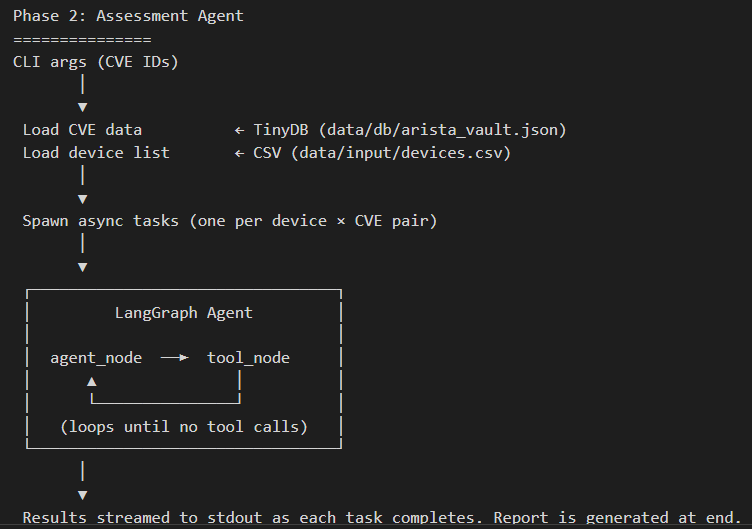
In Part 1, we explored why traditional vulnerability scanning often falls short due to high false-positive rates and manual correlation. Today, we move into the Software/AI Defined implementation, breaking down the Python architecture that enables our autonomous intelligence pipeline. 1. Phase 1: Building the Extraction Pipeline The goal of Phase 1 is to turn unstructured vendor advisories into a machine-readable database. Intelligence Scraping with crawl4ai The foundation of a context-aware assessment is high-fidelity data. We use crawl4ai to navigate the Arista Security Advisory portal. The tool handles the complexities of modern web rendering and delivers a clean Markdown version of the advisory to our extraction agent. Structured Extraction with Pydantic To ensure the LLM outputs are reliable, we define a strict model that acts as a blueprint for the extracted data. Python class Vulnerability(BaseModel): cve: str = Field(description="CVE identifier, e.g. CVE-2024-1234") affected_os: List[str] = Field(description="Affected EOS versions") affected_platforms: List[str] =…
Revolutionizing Vulnerability Management: Scaling CVE Assessments with AI Agents: Part 1

  • Post category:AI
  • Reading time:3 mins read

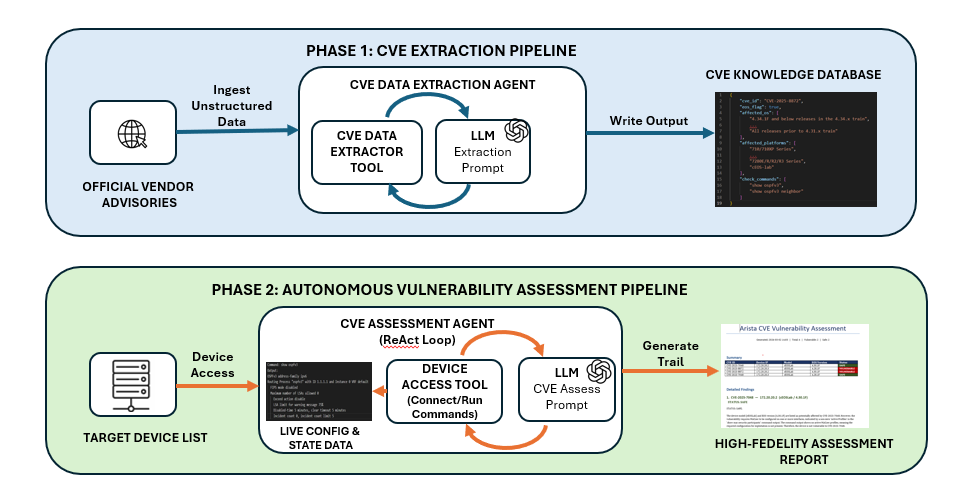
In the current cybersecurity landscape, determining if a system is truly vulnerable is a tedious, high-stakes game of manual correlation. Traditional vulnerability management relies on a fragile process: manually matching OS versions, hardware platforms, and—most critically—specific configuration states against security advisories. While commercial scanning software can automate the retrieval of OS and hardware data, they often struggle with the nuanced "if/else" logic required for a high-fidelity assessment. For example, a CVE might only be exploitable if a particular feature, like MACsec or OSPFv3, is actively configured. Translating these human-readable conditions into code is time-consuming and prone to error, frequently resulting in a flood of false positives or, worse, missed detections. I am excited to showcase a more intelligent approach: AI-Powered CVE Agents. By leveraging LLMs and agentic workflows, we can transform unstructured vendor advisories into a precision-guided assessment pipeline. Scalable AI Agent Architecture For Config-Aware Vulnerability Assessment Phase 1: Intelligent…